
Start with units, not a guessed load
A bulk-material conversation is easier when the measurements are clear. For a roughly rectangular area, record its length and width in feet and the depth you are considering in inches. Write the units next to each number. “Twelve by ten by three” is ambiguous without them.
This article explains geometric volume only. It does not choose an appropriate depth for a material, account for compaction or waste, certify a vehicle load, or establish a final purchase quantity. Patio Supply’s purchasing-estimator assumptions still require review. Bring your measurements to the team so the actual material and ordering unit can be confirmed.
Why the divisor is 324
One foot contains 12 inches, so divide an inch depth by 12 to express it in feet. Length × width × depth, all in feet, gives cubic feet. A yard is 3 feet, so a cubic yard contains 3 × 3 × 3 = 27 cubic feet. Combining the two conversions gives 12 × 27 = 324.
For this unit combination, the formula is: cubic yards = length (feet) × width (feet) × depth (inches) ÷ 324. If your depth is already in feet, divide by 27 instead. If any measurement uses a different unit, convert it first rather than applying the same divisor blindly. NIST’s rectangular-volume guidance likewise emphasizes using the same unit for every dimension before multiplying.
A worked rectangular example
Suppose an area is 12 feet long and 10 feet wide, and you want to discuss a 3-inch layer. Its area is 12 × 10 = 120 square feet. Multiply by the example depth: 120 × 3 = 360. Divide by 324: 360 ÷ 324 = 1.111… cubic yards, or about 1.11 cubic yards.
Check the result another way: 3 inches is 0.25 feet; 120 square feet × 0.25 feet = 30 cubic feet; 30 ÷ 27 = 1.111… cubic yards. Both approaches agree because the units agree. The 3-inch depth is simply an example, not a recommended depth for every product.
Separate rectangles and keep uncertainty visible
For several rectangular areas, calculate each one separately and add the volumes. Use a sketch to identify which areas share a depth and which do not. Do not count the same corner twice. A curved or uneven area needs a more careful measurement approach; a rectangle that surrounds it may overstate the actual space.
If the depth changes, the site is not level or the measurements are approximate, tell the team. Keep the unrounded measurements as well as the rounded result. Do not add an invented universal percentage for waste or compaction: those are product and project questions, not part of this geometric formula.
Cubic yards do not tell you tons or vehicle capacity
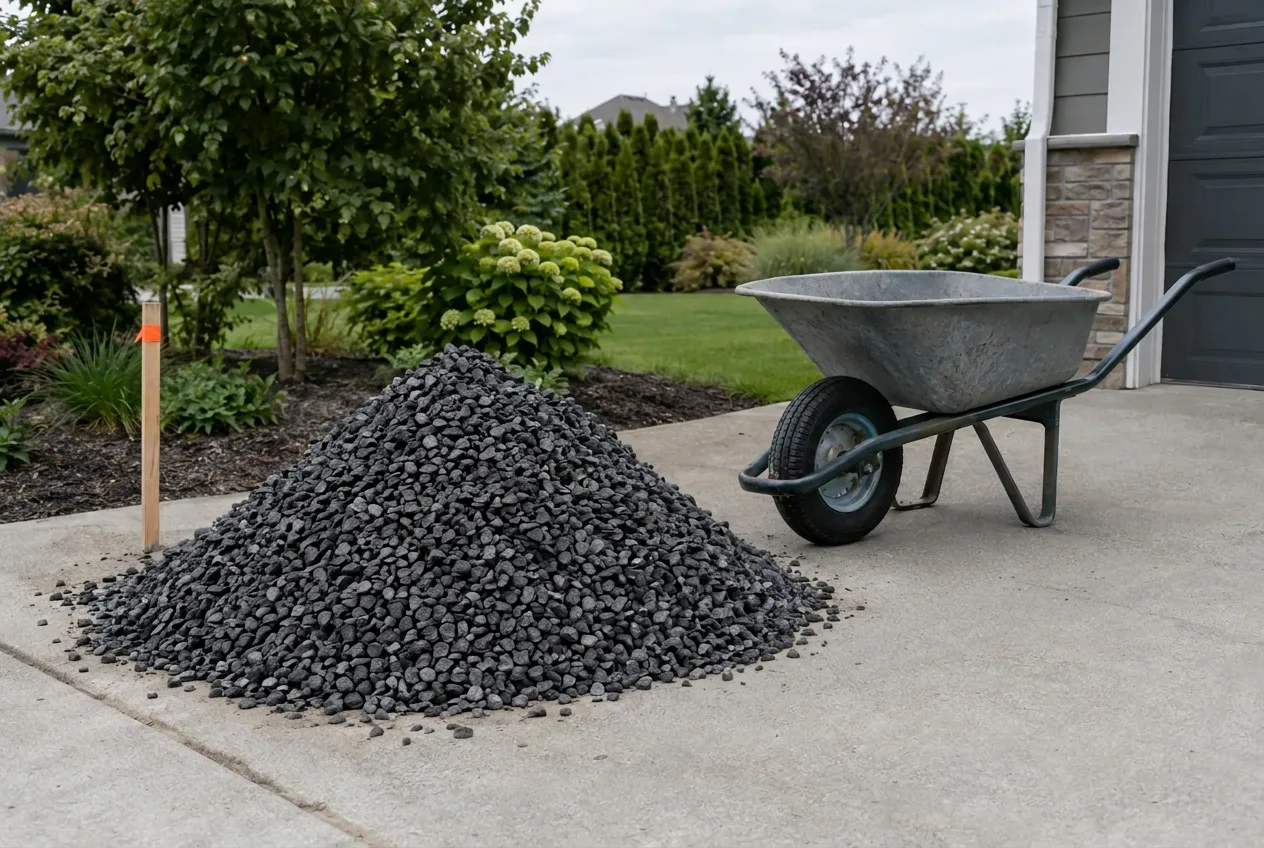
Volume describes space; weight depends on the material and its condition. There is no single honest tons-per-yard figure for every bulk product. Confirm how the chosen material is sold and what quantity discussion is needed. Black Slate Chips, for example, should be requested by its exact product name, with your measurements and intended use.
A pickup truck or trailer’s safe load is not established by this calculation. Check the vehicle ratings and talk with the team before arranging pickup. For delivery, provide the address, proposed drop location and access notes. You can add a material to your quote request with a quantity still unknown, then explain the measured area rather than guessing a conversion.